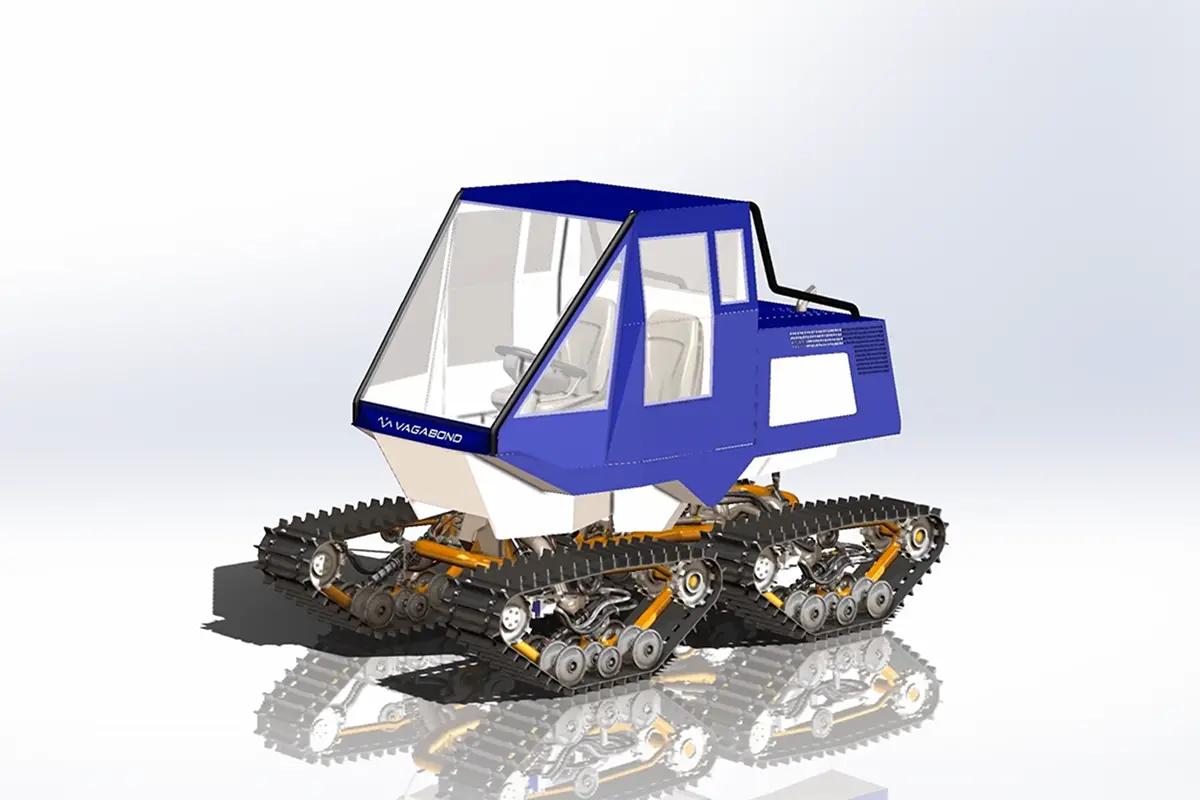
Vagabond by Caron Mobile

Cross every terrain. Reach every site.

A tracked all-terrain vehicle for the Canadian Far North and unforgiving regions.

Move differently

The territory doesn't stop where the roads end.

Where roads and conventional mobility stop, Vagabond takes over. The Canadian Far North, roadless regions, frozen rivers and remote work sites cover vast territory standard vehicles can’t reach. Built for these environments, Vagabond carries its load, its crew and its mission all the way through, whatever the season.

At the heart of the vehicle

What Vagabond does and why it matters.

Vagabond’s capabilities are organized into four families. Each addresses a specific terrain challenge: tread lightly on fragile ground, navigate without a human on board, propel without interruption, keep the crew ready to work.

01

Light mobility

  • Light footprint (<2,000 lb full of gas)
  • Agility and maneuverability
  • Low center of gravity
  • Airliftable
  • Low ground pressure
  • Ground-friendly on passes and turns
  • Power-assisted steering on all four tracks

To cross without sinking, turn in 8 feet, hold the slope where others tip over.

Pictogram showing the Vagabond's light mobility and agility
02

Autonomy and teleoperation

  • Local radio control
  • Satellite teleoperation
  • Autonomous driving (GPS and AI)
  • 8-hour autonomy in continuous work
  • Standby mode down to -40 °C
  • Connected vehicle
  • Follow mode
  • 110 L tank · under 15 L/h
To operate without a human on board, from a remote office, or on long missions.
Pictogram showing satellite autonomy and Vagabond teleoperation
03

Propulsion platform

  • Four-corner hydraulic propulsion
  • Second-order suspension
  • Components proven in extreme conditions
  • Hydraulic system · 20 L biodegradable oil

To match the terrain, attack the obstacle, and last.

Pictogram showing the Vagabond's four-track hydraulic propulsion
04

Utilities

  • Modular storage
  • Climate-controlled cabin (heating and air conditioning)
  • High-visibility cabin
  • Trailer available
So the crew arrives ready and leaves without a break.
Pictogram showing the conditioned cabin and Vagabond utilities
Mechanical architecture

Rethink the components rather than stack them.

Two transmission components found on every conventional off-road vehicle are gone from Vagabond. In their place, architectures designed for the terrain it has to cross.

Second-order suspension

Inspired by human biomechanics, Vagabond’s suspension stacks two passive damping stages in series. Three pivots echoing the ankle, the leg, and the knee absorb the terrain instead of fighting it. Reduced vibration, distributed shocks, continuous traction even at speed on rough ground.

Schematic of the Vagabond's biomimetic suspension inspired by the human ankle, leg, and knee in series

Four-track hydraulic propulsion

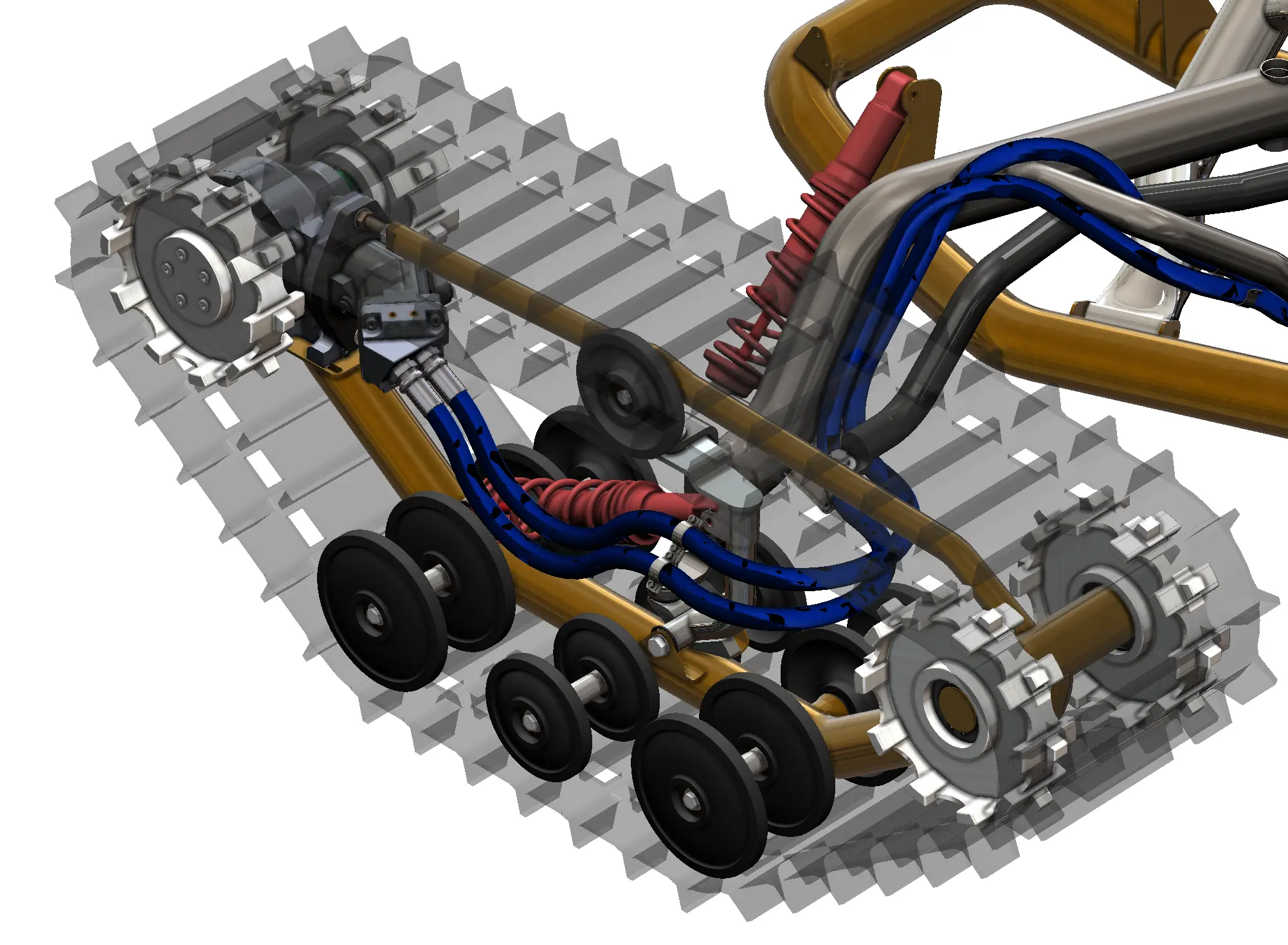
The transmission is gone from Vagabond, replaced by a hydraulic circuit. The differential and transfer case are gone too. Fewer parts, fewer failures, more ground clearance, and full traction control at every track.

Schematic of the Vagabond's hydraulic circuit with motors on each of the four tracks
Key numbers

Performance built for remote territories.

Four thresholds that define what Vagabond can cross, carry and endure where mistakes are costly.

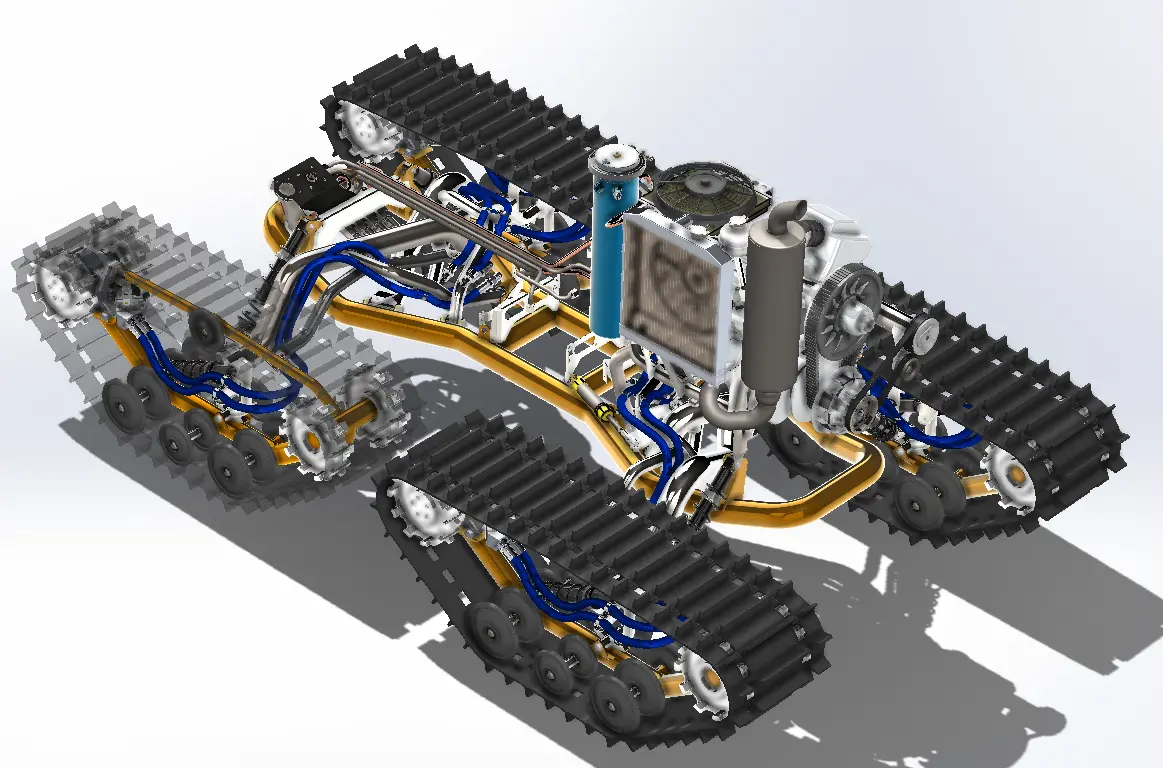
3D render of the Vagabond tracked all-terrain vehicle, blue, on a white background

110 L

Tank · less than 15 L/h in continuous operation

-40 °C to +40 °C

Operational temperature range

100%

Maximum climbable slope

2,000 lb

Towing capacity
Applications

Three priority mandates.

Vagabond was built for applications where reliability, autonomy and light weight decide the mission. Three mandates shape the program today.

Mining industry

Industrial B2B

For operations on remote sites. Vagabond combines reliability, agility, long autonomy and amphibious capability to link hard-to-reach zones to fixed infrastructure.

Defense and public services

Government · Defense

For missions where humans can’t always be on board. Vagabond brings long-distance teleoperation, connectivity and a light footprint to patrol, monitor and intervene.

Northern expedition and tourism

First Nations · Outfitters

For outfitters, guides and First Nations. Vagabond reaches in comfort the territories only snowmobiles can access today, with climate-controlled cabin and local radio control.

Full specifications

Spec sheet.

All values below were validated in tests on the Rev. 3 prototype. Each vehicle’s final configuration is adjusted to the application.

Dimensions and weight

Empty weight
1,700 lb
Loaded weight
Less than 2,000 lb
Dimensions (L x W x H)
120 x 72 x 84 in
Ground clearance
18 in

Performance

Maximum speed
40 km/h
Average speed in transport mode
about 25 km/h
Speed in work mode
5 to 15 km/h
Turning radius
8 ft

Powertrain

Engine
Gasoline + hydraulic propulsion
Clutch
Hydraulic
Amphibious mode
Standard
Motorized trailer
Optional
Program status

Vagabond is in pre-production.

The Vagabond program entered manufacturing pre-production after three years of prototype iteration. The current Rev. 3 carries the core capabilities for the first industrial customer trials. Subsequent iterations will extend long-distance teleoperation and autonomous driving.

Status · Rev. 3

Manufacturing pre-production, open to industrial customer trials.

Price · From $85,000

Final configuration adjusted per vehicle and per application.

Availability · From 2027

First deliveries to industrial customers. Lead time about 6 months after purchase contract signature.

Contact

Talk to an engineer.

For industrials, institutions and government agencies. Specify the type of inquiry and Caron Mobile will respond shortly.

Contact form